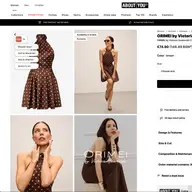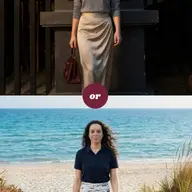
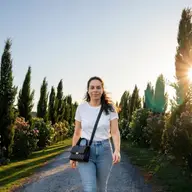
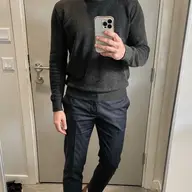
Your first photo is you, alone, in daylight, in a color from your own palette. The rest of the set shows the life you’d actually bring to the date: where you go, what you do, who you’re with, and how you dress on an ordinary good day.
That’s the whole idea. The rest of this post is how to get there with clothes you already own, without a photographer and without a single filter. If you want the wider picture (photos, the date itself, what the apps allow), start with the dating style guide.
The photo set as a story, not a highlight reel
A highlight reel is six versions of your best night out: same dress, same lighting, same angle. It looks great, and it tells the other person very little.
A story is six different moments. A clear photo of your face. One full-length photo. One of you doing something you love. One with friends. One dressed up. One wild card that starts a conversation. Each photo answers a different question someone has before they meet you, and the outfits change with the moments, because your life does.
The useful test: if someone met you on a Tuesday, would they recognize you from the set? If the answer is “only if I’d just come from a wedding”, the story needs more Tuesdays.
The group-photo problem
Group photos are where good profiles go to get confusing. Four friends, similar hair, similar outfits, and the other person has to compare faces across your photos to work out which one is you. Most won’t bother.
The fix is simple:
- One group photo at most, and never first. Bumble’s guidelines require at least one photo that shows only you with your full face clearly visible (as of October 14, 2026). Make that your first one.
- Be easy to find. Stand in the middle or the front, and wear something that stands out a little from the group: a color, a layer, a pattern.
- Two people beats six. A photo with one or two friends shows you have people, without the puzzle.
Filters, and why they backfire at the door
A face filter or a heavy edit works exactly until the first coffee. Then the person across the table compares the photo with you, in daylight, and the difference is the first thing they notice. That’s a bad first thing.
There’s a rules side too. Bumble’s guidelines don’t allow photos so distorted or heavily edited that it isn’t clear it’s you, and Tinder, Hinge and Bumble all offer verification that compares a selfie with your profile photos (as of October 14, 2026). The details, with links to each app’s rules, are in do AI photos work on dating apps.
What’s fine: cropping, straightening, a little exposure or warmth so the photo looks like the moment did. What isn’t: anything that changes your face or your body. If you’d be nervous about the person seeing you next to the photo, the edit went too far.
Outfits by slot, from your own closet
Here’s what to wear in each of the six photos, from a normal closet.
| Photo | What to wear | What to avoid |
|---|---|---|
| 1. Headshot | One solid color that suits you, a simple neckline, hair and face clear | Busy prints, a hat or sunglasses, heavy filters |
| 2. Full length | A complete outfit you’d wear on a date, shoes included | An outfit you’d never actually wear out |
| 3. Doing something | What the activity really needs: hiking boots for a hike, an apron for cooking | Heels in a hiking photo |
| 4. With friends | Something that stands out a little from the group | Matching the group so nobody can find you |
| 5. Dressed up | Your dressiest version: a dress, a blazer and trousers, a good top | Six photos from the same night |
| 6. Wild card | Everyday clothes on a good day | The headshot outfit again |
For the headshot color, the best answer is personal: the colors you get compliments in, the ones your closet already leans toward. Solid mid-tones (navy, olive, rust, burgundy, soft blue, warm gray) photograph more reliably on a phone than pure white or pure black. Colors that photograph well has the details.
The dressed-up photo without a wedding
Most people’s only dressed-up photos are from weddings, which is why so many profiles have a cropped bridesmaid dress and somebody’s shoulder in them. You don’t need an event to have the photo.
Put on the dressiest outfit you’d wear to a nice dinner. Go out at the hour before sunset, or stand near a big window. Have a friend take ten frames, or prop the phone on a ledge and use the timer. Walk, turn, laugh at something. That’s the photo. It shows the other end of your range, and it’s an outfit you’ll actually wear on a date.
Shooting alone
You can shoot most of the set alone in an hour:
- Face a window or stand in open shade. Avoid overhead lights and direct midday sun.
- Prop the phone at chest height, a few steps away, and use the timer with burst mode.
- For the full-length shot, step back until there’s space above your head and below your feet.
- Plan three outfits and change between rounds.
- Crop to 4:5.
The full method, including the activity photo on your own, is in how to take dating photos by yourself.
The Studio step
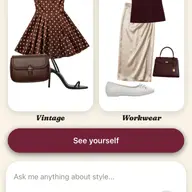
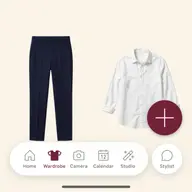
Choosing the outfit is the part that eats the afternoon. In Clottr, you try two or three candidates from your own closet on your own photo, compare two on one This or That card in Studio, and frame the winner in a Studio template. If you’ve used Clottr for a while, Wardrobe Insights already shows the color families your closet leans toward, and Style DNA records your color leanings, so the headshot color can start from what you already wear.
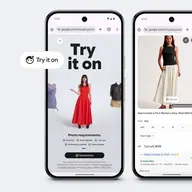
Then use it: put the try-on straight into your set, or shoot it for real in that outfit and light. The apps are against fake profiles, and a try-on is you, with your own face, in clothes you own. Lead with a clear, recent photo of your face, and leave out any render where your face looks off. Try-on is an approximation for judging the look, not the fit. The step-by-step version is in plan your dating photos with Studio.
Frequently asked questions
What should I wear in my Hinge photos?
A solid color that suits you for the first photo, a complete outfit you’d wear on a date for the full-length photo, real activity clothes for the activity photo, and one dressed-up look. Use different outfits across the set, from clothes you actually wear. Hinge shows photos next to your prompts, so let them answer each other.
Should I use filters on dating app photos?
No face filters and no heavy edits. Cropping and a little exposure are fine. The person you meet will compare your photos with you, and Bumble’s guidelines don’t allow photos so edited that it isn’t clear it’s you (as of October 14, 2026).
How many group photos should I have on Bumble?
One at most, and not first. Bumble’s guidelines require at least one photo that shows only you with your full face clearly visible (as of October 14, 2026), and the other person shouldn’t have to guess which one you are.
Should my first dating photo be a selfie?
It can be, if it’s a clear, well-lit photo of your face with no filter. A photo taken by a friend or on a timer, facing a window, usually looks more natural than an arm’s-length selfie.
What should I wear for a dressed-up dating photo?
The outfit you’d wear to a nice dinner: a dress, or a blazer with trousers, or a good top with tailored trousers or a skirt, and shoes you can walk in. You don’t need a wedding: the hour before sunset and a friend with your phone are enough.
See which of your clothes photograph best: start with what to wear in your dating profile photos, then try the candidates on in Clottr before you shoot.