


Your closet is full, the door barely shuts, and you still hear yourself say “I have nothing to wear.” Then you put on the same jeans as Tuesday and leave the house mildly annoyed with yourself.
Here’s the thing: that isn’t a clothing problem. It’s an information problem. You own plenty. What you don’t have on a weekday morning is a clear picture of what’s in there, what goes with what, what’s clean, and what suits the day you’re actually having. So your brain does the sensible thing and gives up.
I debugged mine like a bug report, and it broke down into five causes. You’ll probably recognize more than one. Each comes with a question to ask your closet. Then there’s a 15-minute audit you can do tonight, no app needed.
1. You can’t see what you own
The question: could you list every jacket you own without opening the closet?
A closet is built for storing clothes, not for browsing them. Things hang behind other things. Sweaters get folded under other sweaters. There’s a drawer that sticks, a box under the bed, a bag of “summer stuff” on the top shelf.
If you can’t see a piece, it isn’t an option. It could go perfectly with the trousers in your hand. At decision time, it doesn’t exist.
You’re looking at a lot of clothes, just not at outfits. A closet shows you sleeves and hangers, not combinations.
2. Orphans: pieces that pair with nothing
The question: can you name two outfits for this piece using only what’s already in your closet?
Most closets have orphans. The printed shirt from the sale rack. The skirt in a color nothing else matches. The shoes bought for one wedding and never again. Each one looked great on its own, which is exactly the problem: it only works on its own.
Orphans are sneaky because they look like options. You count them every time you open the door, try to build an outfit around one, find nothing that goes, and hang it back up. Do that twice and you stop trying. You never stop counting, though.
An orphan isn’t always a bad piece. Sometimes it’s one partner away from working: a plain bottom in the right color, a neutral layer. Sometimes it’s a mistake you paid for. Most of mine were sale buys. These days I ask the two-outfit question before checkout, not after, which is the same test from how I stopped buying clothes I never wear, pointed at what’s already on the rack.
3. Formality mismatch: a closet built for a life you don’t live
The question: does your closet look like your calendar?
A lot of closets are dressed for a different person. Office clothes from a job that went remote. Going-out tops from a few years ago. Hiking gear for the hiking you were going to start. Meanwhile the life you actually live (school drop-offs, video calls, the odd client lunch) gets covered by the same three casual pieces. Or the reverse: all soft weekend clothes, a calendar full of meetings, and exactly one blazer.
“Nothing to wear” often means “nothing to wear to this.” The closet is full, just for the wrong days. If your gap is the in-between, not a suit and not a hoodie, here’s what business casual actually looks like.
4. Rotation blindness: the same five things on repeat
The question: when did you last wear something from the back half of your closet?
It’s 7:42. You have one sock on and no patience. So you don’t choose an outfit, you default to one. The jeans that always work, the sweater that goes with them, the shoes by the door. Deciding is annoying, and “the usual” costs nothing to decide.
A rotation you picked on purpose is fine. Rotation blindness is the one you didn’t pick. The front of the closet wins every morning because it’s closest and safest, and everything behind it slowly stops registering as an option. A few months later you’re wearing a small slice of what you own and feeling bored with all of it.
5. Laundry and season: part of the closet is off the table
The question: is the outfit you’re picturing clean, and does it suit this week’s weather?
You see the wool sweater in midsummer and count it. Same with the linen shirt in midwinter. Your favorite jeans are in the hamper, the good white shirt still needs ironing, and the trousers that go with everything are on the chair. (Everyone has the chair. I have the chair.)
So the closet looks full, but the part you can wear today is much smaller. And the pieces in the wash are usually your best ones, because they’re the ones you wear. Without them, every combination you know falls apart.
The 15-minute closet audit
No app, no trash bags, and no pulling everything onto the bed. Set a timer for 15 minutes. A big closet takes longer; if yours does, audit one rack tonight and the next tomorrow. Each step goes after one of the five causes.
- Photograph everything (3 minutes). Take a photo of every rack, shelf and open drawer. Don’t tidy first. Now your whole closet fits on one screen, which is more than the closet itself can say.
- Set aside what’s unavailable (2 minutes). Push out-of-season pieces to one end of the rack. Check the hamper and the chair. None of it counts this week.
- Pull the orphans (4 minutes). Touch each piece and name two outfits it belongs to, using only what’s in the closet. Can’t name two right away? It goes on the bed.
- Compare closet and calendar (2 minutes). Write your usual week in one line, for example “four office days, two relaxed days, one dinner out.” Then look at the rack. If the mix of clothes doesn’t match the mix of days, you’ve found your formality gap.
- Name your same five (1 minute). Write down the pieces you wear on repeat. They’re probably at the front, or in the hamper from step 2.
- Set out tomorrow from the back (2 minutes). Choose one clean, in-season piece you haven’t worn in a while and hang tomorrow’s whole outfit on the door with that piece in it. Decided tonight, not at 7:42.
- Give every orphan a verdict (1 minute). Three labels: “needs a partner” (write down what it needs), “needs a fix” (tailoring, a button, a stain), or “donate.” One label per piece. No “maybe.”
You come out with a photo inventory, a list of orphans with verdicts, and tomorrow’s outfit already on the door. If you want to go further than 15 minutes, there’s a step-by-step guide to wearing more of your wardrobe.
Fixing each cause
The audit is a snapshot. The causes come back, so here’s what keeps each one fixed, by hand and in Clottr (our app, so weigh that column accordingly).
| Cause | Fix by hand | How Clottr does it |
|---|---|---|
| You can’t see what you own | Keep the photo inventory current | Digital Wardrobe, filterable by category, formality and color |
| Orphans | The two-outfit test, then a verdict | Wear tracking shows the pieces you never reach for |
| Formality mismatch | Compare the closet with your calendar | A formality tag on every item, and a formality filter |
| Rotation blindness | Set out tomorrow the night before | Daily Fit each morning, and Deep Cuts for pieces you haven’t worn lately |
| Laundry and season | Set aside what’s unavailable | For the season part: season tags and a Daily Fit matched to the forecast |
How Clottr handles each one
Here’s the Clottr column in more detail.
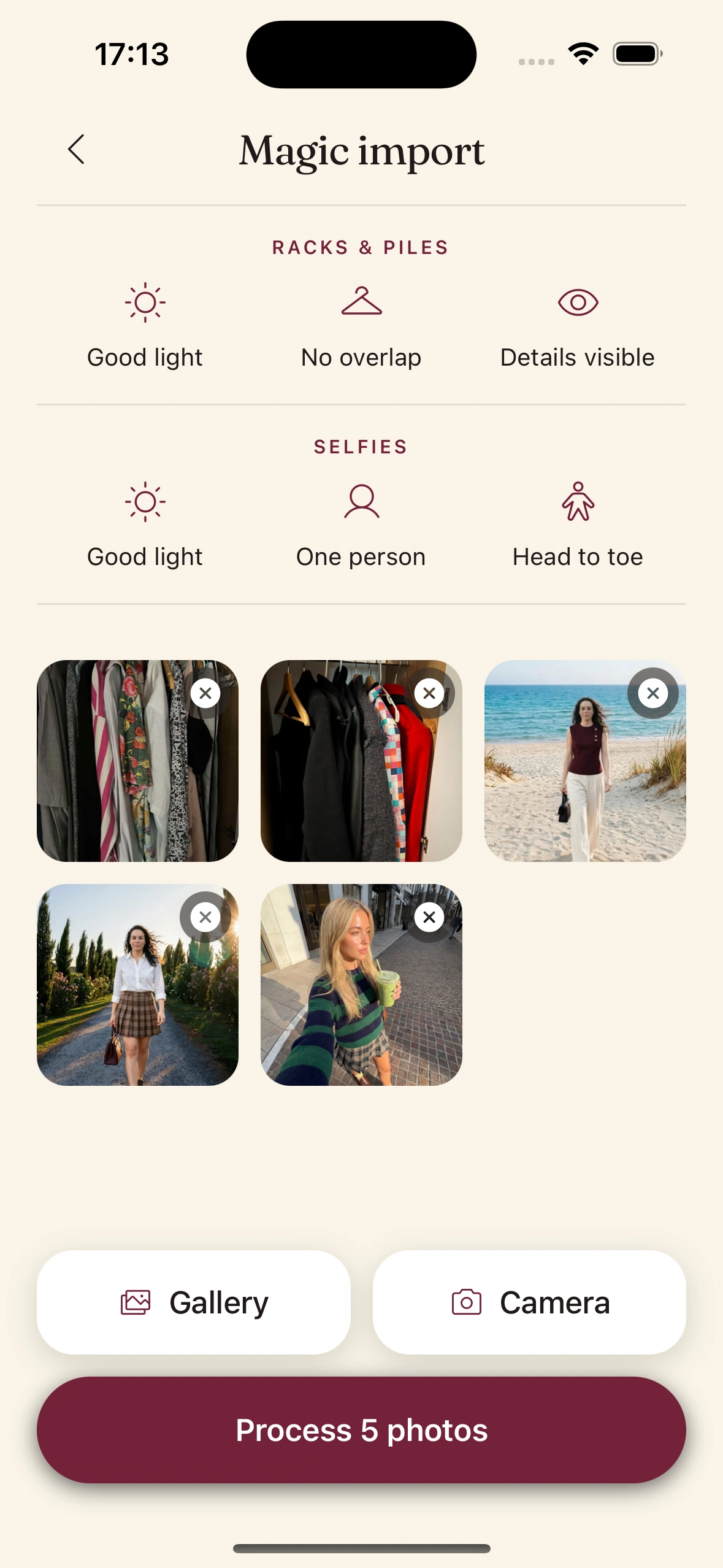
Seeing it all. The Digital Wardrobe is the photo inventory from step 1, made browsable. Add pieces by photographing one item, a whole rack or an outfit you’re wearing (each garment is pulled out separately), by uploading from your camera roll, or by importing product images from any online store. The AI removes the background and tags each piece, and you filter by category, formality and color. About 30 items is enough to start. Include a few from the back of the closet: the forgotten pieces are the point.
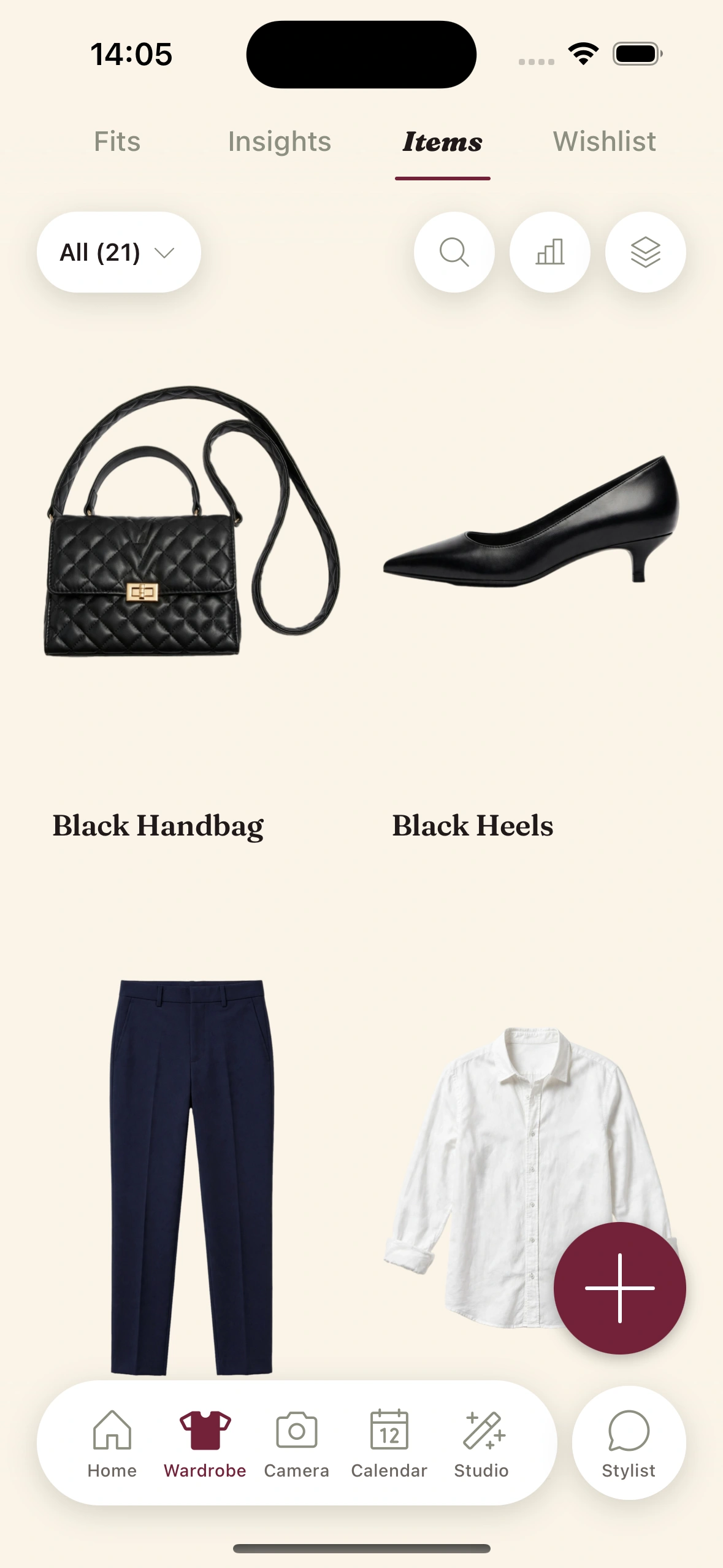
Formality. Each item is tagged across roughly 19 attributes, including category, color, material, fit, formality and season, and every tag is editable. Filter by formality and you can see which of your pieces are dressed-up and which are casual, which is the closet half of step 4. The calendar half is still yours to write down.
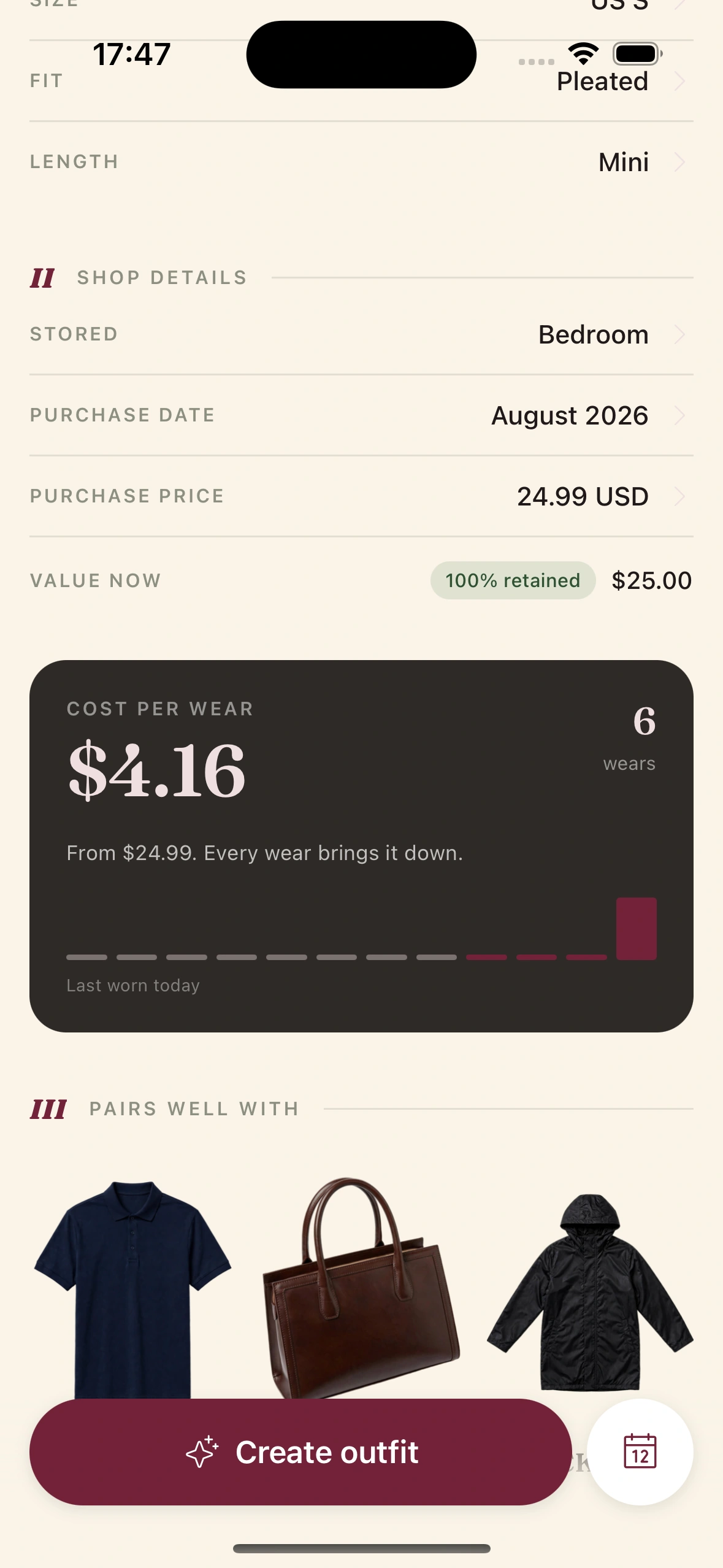
Orphans and rotation. Wardrobe Insights tracks what you wear: the Daily Fits you tap to wear, events on your calendar, wears you log by hand, and a predicted wear frequency. Each item also gets a cost-per-wear, which is a sobering number for the sale buys. Deep Cuts works on rotation blindness: it brings back pieces you haven’t worn lately that suit today, so the forgotten flannel shows up on the first cold morning, not in the middle of a heat wave.
The morning decision. Daily Fit gives you an outfit from your own closet each morning, matched to the forecast and, if you connect it, your calendar. Calendar event details stay on your device. It’s ready by 7:30 by default (twelve minutes before the 7:42 problem), by email, push or both. Nothing is re-worn back to back, which takes the edge off the same-five habit.

Clottr is coming soon for iOS and Android, and the waitlist is open.
What an app can’t fix
An app can’t fix a closet full of things you don’t like. If you can see a piece clearly, you know exactly what it goes with, and you still don’t want to wear it, that’s not an information problem. That’s a donate pile.
What wear tracking gives you is evidence. After a few weeks, the pieces you never reach for are right there in the numbers, which is harder to argue with than guilt. What goes and what stays is still your decision.
Frequently asked questions
Why do I always wear the same clothes?
Usually because the outfit you already know is the cheapest decision in the closet. Everything else needs thought you don’t have in the morning. Set out tomorrow’s outfit the night before, with one piece from the back of the closet in it.
How many outfits can I make from the clothes I own?
For outfits made of a top, a bottom and shoes, multiply your tops by your bottoms by your pairs of shoes to get the upper limit (dresses and layers add more). As an example, 5 tops, 4 bottoms and 3 pairs of shoes give 5 × 4 × 3 = 60 combinations on paper. Some will clash or mix formality levels, but even a third of them would be 20 different outfits. An orphan adds no working combinations, however good it looks on the hanger. The 3-3-3 rule runs the same math on just 9 pieces.
Should I declutter before I organize my closet?
Only partly. Take out what’s damaged or no longer fits you, then audit before you get rid of anything else. Decluttering before you know what you actually wear is guessing, and guessing is how good pieces leave while the orphans stay.
Is “nothing to wear” a style problem or an organization problem?
Usually it’s an organization problem first. If you can’t see your clothes, don’t know what goes together, or forget what’s in the wash, better taste won’t help yet. If you can see everything clearly and still don’t like most of it, it’s a style problem, and the starter post on how to dress better is a good next read.
How do I find out which clothes I actually wear?
Track it for a few weeks. The no-app version is the hanger trick: turn every hanger backward, and when you wear something, hang it back the normal way. Whatever is still backward at the end is your answer. In Clottr, Wardrobe Insights tracks wears from the Daily Fits you tap, your calendar and manual logs, and shows cost-per-wear for every item.
See everything you own. Then wear it: photograph your closet, back half included, into Clottr’s Digital Wardrobe and find out what’s been hiding back there.
Want the backstory? Read how I stopped buying clothes I never wear. For mornings, see what to wear today.