Virtual try-on technology has come a long way. A few years ago, the best you could get was a flat overlay of a shirt on a mannequin using a Snap or Instagram filters. Nowadays, AI can generate a photorealistic image of you wearing a specific garment in seconds (only Clottr).
But not all virtual try-on apps work the same way. Some are still glorified Snapchat filters. Others only work inside a store’s ecosystem. And a few are trying to change how we shop for clothes.
I’ve spent the last year tinkering, working and testing every major virtual try-on tool and AI model I could find. Here’s what I learned.
What makes a good virtual try-on app?
Before comparing individual apps, let’s talk about what actually matters. A virtual try-on tool is only useful if it meets a few criteria and features:
- Uses your photo - not a generic model that vaguely resembles our body type. We need to see ourselves in the clothes.
- Realistic rendering - the generated image should look natural, not like someone Photoshopped a flat image onto our body.
- Speed - if it takes 30 seconds to generate one image, we’ll never use it for real shopping decisions.
- Works across stores - working only at one retailer defeats the purpose. We shop at dozens of places; the try-on tool should work everywhere.
- Wardrobe info - seeing how a new item looks on us is helpful, but seeing how it fits with clothes we already own is next level.
Most tools offer one or two of the above. Almost none get all five.
The best virtual try-on apps in 2026
Here’s how the major players compare:
| Feature | Clottr | Google Virtual Try-On | Amazon Virtual Try-On | StitchFix |
|---|---|---|---|---|
| Uses your actual photo | Yes | No (generic models) | Limited (shoes/accessories) | No |
| Works on any store | Yes (browser extension) | Google Shopping only | Amazon only | StitchFix only |
| Full outfit try-on | Yes (multi-item canvas) | No (single items) | No (single items) | No |
| Wardrobe integration | Yes (full wardrobe context) | No | No | Partial (style profile) |
| AI purchase advice | Yes (“Should I Buy?”) | No | No | Stylist picks |
| Outfit planning | Yes (daily AI outfits) | No | No | Quarterly boxes |
| Speed | several seconds | Instant (pre-rendered) | Instant (AR overlay) | Days (human stylist) |
| Cost | Paid | Free | Free | Styling fee + item cost |
Now let’s break each one down.
Google Virtual Try-On. What is it and how does it work?
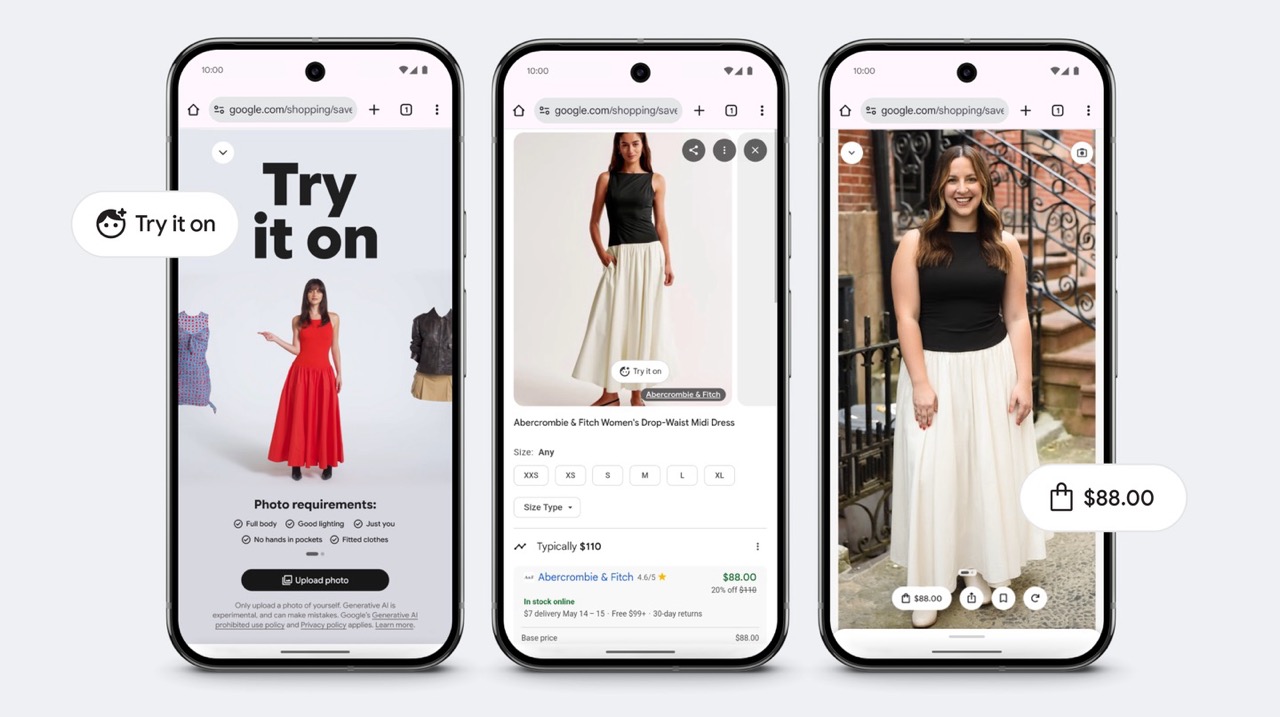
Google’s virtual try-on feature is built into Google Shopping. When you’re browsing products on Google Shopping, some items show a “Try on” button that lets you see the garment on a range of pre-generated model images representing different body types, skin tones, and sizes.
What it does well: Google’s rendering quality is excellent. The AI-generated images look realistic and the fabric draping is convincing. It’s also instant, there’s no processing time because the images are pre-rendered.
Where it falls short: You don’t see yourself in the clothes. Google shows you how a garment looks on someone who might share your general body type, but that’s fundamentally different from seeing it on you. Your shoulders, your proportions, your skin tone. It’s also locked to Google Shopping, so it only works for products Google has decided to have try-on support.
The bigger problem: Google Virtual Try-On doesn’t know anything about your existing wardrobe. It can show you how a jacket looks on a model, but it can’t tell you whether that jacket goes with the pants you already own or duplicates something in your closet. It’s a preview tool, not a styling tool.
Amazon Virtual Try-On. What is it and how does it work?
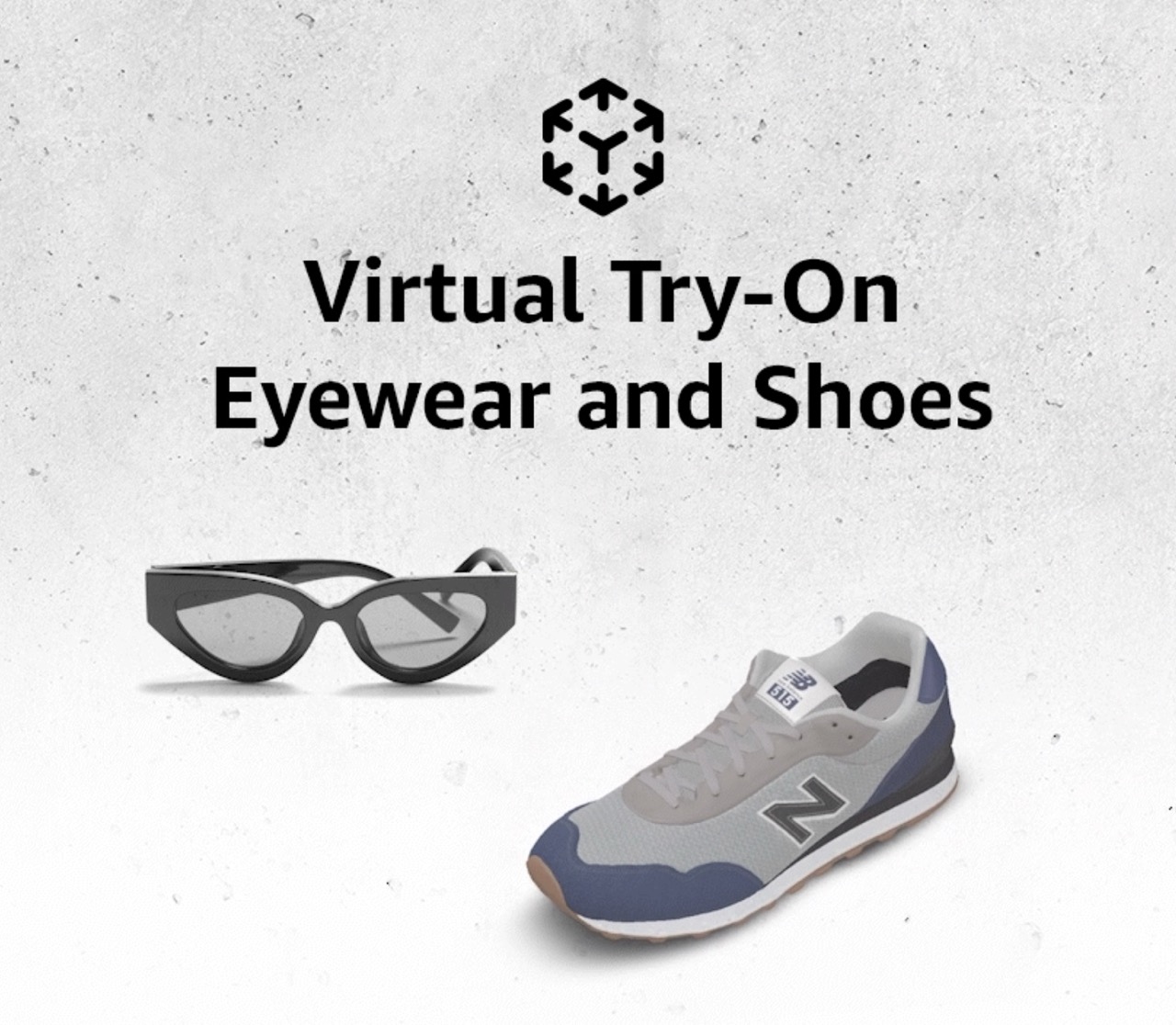
Amazon actually has two different “try-on” features, and they’re often confused:
- Virtual Try-On (AR) - an augmented reality feature in the Amazon app that lets you point your camera at your feet and see how shoes look on you. It’s also expanded to some accessories and eyewear.
- Try Before You Buy - a completely different program where Amazon physically ships you clothes, you try them on at home, and you return what you don’t want within 7 days.
The AR try-on is useful for shoes and sunglasses. The technology is solid, the rendering is real-time, and it uses your camera feed.
Where it falls short: The AR try-on is limited to a small subset of products (mostly shoes and accessories). For clothing, the stuff most struggle with, it doesn’t exist in any meaningful way. And Try Before You Buy, while convenient, is just… ordering clothes and returning them. I don’t want to deal with returns, no matter how easy they make it seem.
The bigger problem: Amazon’s tools are designed to get you to buy more from Amazon, doesn’t matter if you actually need it or will wear it. There’s no wardrobe intelligence, no outfit planning, no assessment of whether a purchase actually makes sense for your style. It’s a store feature, not a personal styling tool.
StitchFix. What is it and how does it work?
StitchFix takes a fundamentally different approach. Instead of virtual try-on, they use a combination of AI and human stylists to curate boxes of clothing for you. You fill out a style profile, a stylist picks 5 items, the box arrives at your door, you keep what you like and return the rest.
What it does well: StitchFix introduced a lot of people to the idea that technology could help with style decisions. The personalization gets better over time as you provide feedback, and having a human stylist in the catches things that pure AI might miss.
Where it falls short: The subscription box model is slow. You wait days or weeks for a box, try things on physically, return what doesn’t work, and repeat. There’s no quick feedback. You also can’t shop anywhere you want, you’re limited to whatever StitchFix stocks up on. And it’s the only option on this list that charges for the styling service itself.
The bigger problem: StitchFix doesn’t give you a virtual at home try-on at all. You can’t see how something looks on you before it ships. The entire model is built around physical trial-and-error. Again, they make it seem easy, but I imaging dealing with refunds once per week, for an entire month until you get that top that matches your style. Annoying!
Clottr. What is it and how does it work?
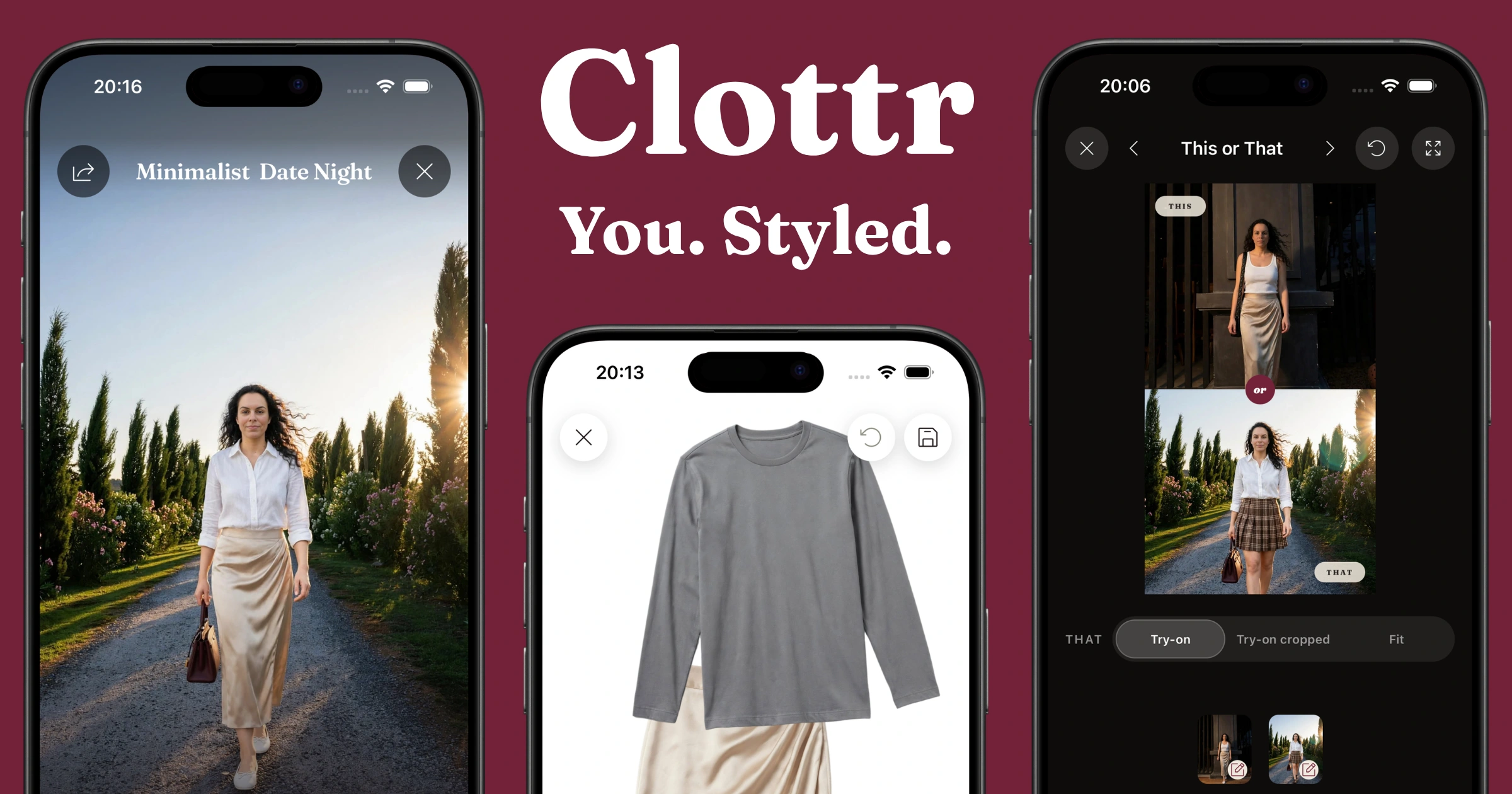
Full disclosure: I’m part of the Clottr team, so take this section with appropriate skepticism. But I’ll try to be as honest here as I was with the competitors.
Clottr’s virtual try-on works differently from the others. You upload a photo of yourself, select any clothing item from any online store (via a browser extension or our app), and AI generates a realistic image of you wearing that item. The whole process takes about several seconds (much faster than any other options that exist today). NB! I know the first question that comes to your mind and no, we do not use any facial / body processing and we do not train any models on your face and body data. Ever! (we are not even allowed to, since we are based in the EU)
But virtual try-on is just one piece. Here’s what sets Clottr apart:
- Full wardrobe integration - You can digitize your entire closet. When you’re considering a new purchase, Clottr checks it against everything you already own. Does it go with your existing pieces? Do you already have something similar? Can you make at least three outfits with it? I personally had a wardrobe with 24 shirts (love them!), but I wore maybe 10 of them per year, my favourite ones. And even from those, 2 I wore probably once or twice on special occasions. Others I bought just in case, or simply since I liked them.
- “Should I Buy?” intelligence - The browser extension evaluates potential purchases across multiple dimensions: style fit, seasonal appropriateness, duplication check, outfit potential, and preference compliance. It’s like having a personal stylist looking over your shoulder while you shop.
- AI outfit planning - Every day, Clottr will suggest outfits from your existing wardrobe based on your schedule, the weather, and your style preferences. This is the outfit planner feature, and it’s the part I love most. Each morning, I get a few fits, already tried on me.
- Multi-item canvas - Unlike other try-on tools that show one garment at a time, you can combine multiple items on a single canvas to see complete outfits. You can also do that while you shop. Imagine, you like a top, but are not sure you have any pants to go with it. No problem, start the canvas with the top, find some pants, shoes, maybe a bag to match it and see them together. Looking good? Try on yourself just to make sure. All before you buy.
Where Clottr falls short: It’s still in beta, so the user base is smaller and the technology is still being refined. The try-on quality, while good, isn’t perfect for every garment type, once or twice it can make the mistake of which items to layer where. If that does happen, just try it again. And because it requires a selfie upload, there’s an inherent trust question about you photo privacy. On this front, I come from close to a decade of enterprise system building experience and as we are based in the EU, privacy is baked into every aspect of the app from day 1 (otherwise it would be illegal!). No training on your face and body data, ever.
Which app should you use?
Here’s my take:
If you just want to see how a specific item looks before buying it from a store, Google (for Google Shopping items) or Amazon (for shoes) will give you instant, frictionless previews. They’re free, they’re fast, and they’re good enough for quick checks.
If you want someone else to do the thinking for you, StitchFix is still a decent option, especially if you don’t know what styles work for you and want human guidance. Just know you’re paying for it and limited to their inventory.
If you want a tool that changes how you shop and dress, that’s where Clottr is trying to go. The wardrobe integration, purchase intelligence, and outfit planning are features that none of the others offer.
The virtual try-on space is moving fast. Two years ago, most of these features didn’t exist. By next year, the gap between “preview tool” and “personal styling AI” will be even wider. The apps that understand your wardrobe, not just the single item you’re looking at are the ones that will be worth using.
What about other virtual try-on apps?
There are dozens of smaller apps worth mentioning:
- Zeekit - Similar to Google’s approach with pre-rendered models. Good rendering quality but limited to Walmart’s catalog.
- Vue.ai - Enterprise tool used by some online retailers. You might encounter it on certain shopping sites without even knowing it. Quality varies significantly by retailer implementation.
- YesPlz - Focuses on visual search and style recommendations more than try-on. Useful for discovering new items but doesn’t replace a virtual try-on.
- Mirrorsize - Specializes in size recommendation using body measurements. Not a visual try-on but solves a related problem (buying the right size).
None of these offer the full wardrobe approach: virtual try-on plus wardrobe integration plus outfit planning plus purchase intelligence that defines the next generation of fashion AI.
How accurate are virtual try-on apps in 2026?
Accuracy has improved dramatically, but it varies by app and garment type.
What works well across most apps: Solid-colored garments, structured items (blazers, jeans, button-downs), items with clear silhouettes. These render convincingly on most platforms.
What’s still tricky: Sheer fabrics, complex patterns (especially when they need to wrap around body contours), layered outfits, and accessories like scarves or belts that interact with multiple garments. These are areas where AI still struggles with physics simulation.
The honest truth: No virtual try-on app replaces physically trying something on. What the good ones do is get you to 80–90% confidence before you buy, which is a massive improvement over guessing based on a flat product photo and a size chart.
If you’re tired of returns and closet regret, even an imperfect virtual try-on saves you time and money. The question is whether you want a simple preview tool or a comprehensive wardrobe intelligence system that helps you make better decisions at every step.
Will virtual try-on replace physical fitting rooms?
Not anytime soon, and probably not ever for certain categories. But for online shopping, which is where most clothing purchases happen now, virtual try-on is becoming super helpful.
The real shift isn’t about replacing fitting rooms. It’s about bringing fitting room confidence to online shopping, where you currently have zero ability to try before you buy (unless you count ordering three sizes and returning two, which isn’t a solution, it’s a workaround).
What should I look for when choosing a virtual try-on app?
If you’re choosing a virtual try-on tool in 2026, prioritize these features:
- Your actual photo, not a model - If the app doesn’t show you, it’s a product preview, not a try-on. What difference does it make from the models already on the site?
- Cross-store compatibility - You shouldn’t need a different app for every store you shop at. That’s going in the direction of the dozens of streaming services, no!
- Wardrobe awareness - The app should know what you already own, or it’s just showing you isolated items without context.
- Speed - Anything over 10 seconds will destroy all desire to use it.
- Privacy - Understand how your photos are stored and processed. With the age of AI, everyone wants to train on any data, this is why we decided to go in the other direction, making sure data training is not even possible on your personal image.
The browser extension approach that some apps (including Clottr) use is particularly promising because it meets you where you’re already shopping, rather than forcing you into a separate app or marketplace.
If you’re more interested in the styling side, read about how to dress better and how to decide what to wear today.